


A lawn that sheds irrigation and a garden bed that dries quickly can look equally thirsty, yet need different management. Choosing a wetting agent starts with understanding what happens to water after it reaches the ground. That makes the buying decision more useful than simply choosing the largest bottle or the strongest-sounding claim.
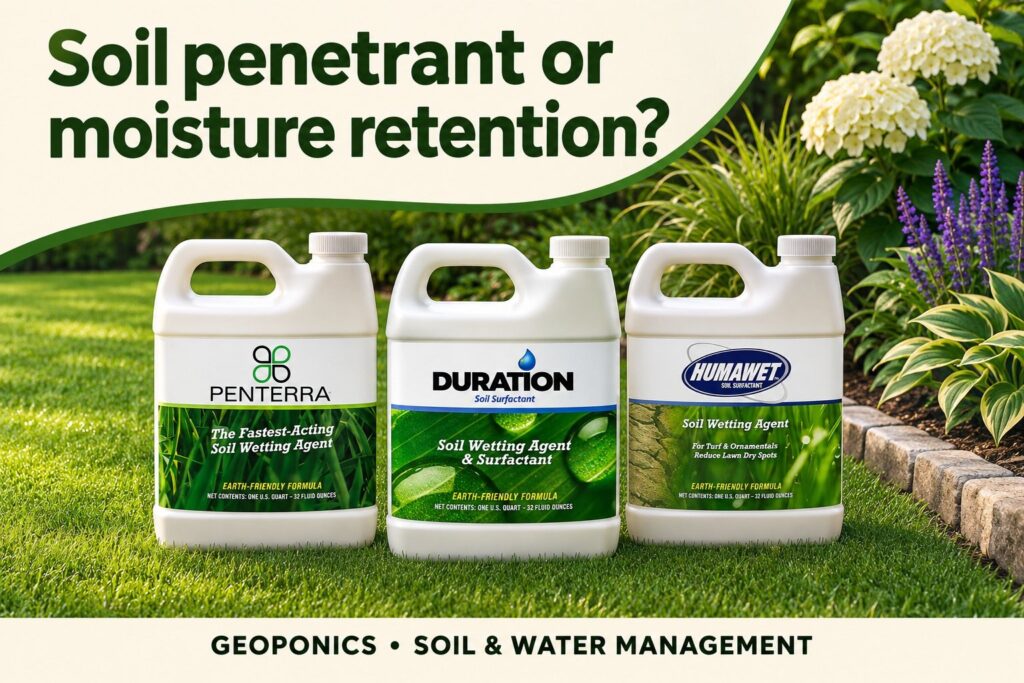
The best wetting agent fits the problem: water entering the soil, moisture distribution, or retention in the root zone. Consider Penterra for penetration and compare Duration or HumaWet when retention is a priority. Match the product’s directions to your plants, equipment and irrigation.
What is the best wetting agent for lawns?
Choose by the cause of uneven moisture. A lawn with water-repellent soil needs help accepting water; a lawn with poor sprinkler coverage needs an irrigation correction. Penterra is a Geoponics option for penetration. Evaluate the treatment on a representative area before extending it across the property.
What is the best wetting agent for garden beds?
HumaWet is a Geoponics option for ornamental beds where root-zone moisture retention is the goal; Penterra fits a water-penetration goal. The right choice depends on the plants, growing medium and watering method. Start by checking whether the bed repels water or simply dries rapidly between irrigations. Select a product with directions for that application, and treat ornamental and edible gardens as separate uses.
What is the best wetting agent for landscape beds?
Consider HumaWet for moisture retention in ornamental landscape beds, or Penterra when water struggles to enter the soil. Choose a product that suits the root-zone problem and can be applied evenly around the planting. Beds with different shrubs, mulch depths and irrigation layouts may not respond uniformly. Map the dry areas first; a single treatment should not substitute for correcting a blocked emitter.
How do I choose a wetting agent for my soil type?
Compare Penterra for penetration with HumaWet for root-zone moisture retention. Observe water behavior as well as soil texture. Record whether water beads, runs downhill, ponds or disappears while soil beneath remains dry. Then identify the plants and measure the area. Use those observations to choose between a penetration-focused treatment and a retention-focused program.
What is the best wetting agent for water-repellent soil?
Look for a soil-applied product intended to improve wetting and penetration. Penterra belongs in that comparison. Evaluate whether irrigation reaches previously dry soil after treatment; a greener surface alone does not show how water moved through the profile.
Which wetting agent should I use for sandy soil?
Consider HumaWet when moisture retention is the goal, and Penterra when water-repellent sand needs improved wetting. First distinguish water-repellent sand from sand that accepts water but stores little between irrigations. Those conditions can occur together, but they are not identical. Select a program around measured root-zone moisture, then adjust watering as observations justify. Avoid assuming every sandy site needs the same treatment.
Can a wetting agent help water penetrate clay soil?
Penterra can help improve wetting where water repellency contributes to poor penetration in clay soil. It may help where poor wetting contributes to the problem. Clay texture, compaction and drainage restrictions also affect water movement. Check whether the soil is actually repellent before treatment, and retain physical soil improvement and irrigation management as part of the plan.
Are liquid or granular wetting agents better for my application?
Penterra is a liquid option for a penetration-focused application; choose equipment that lets you measure and distribute it accurately. Choose the format you can apply accurately. Liquids require careful measuring and spray or drench distribution; granules require an appropriate spreader and activation according to their directions. Compare formulation, treatment area and follow-up watering rather than assuming one physical form is always stronger.
What is the difference between a soil penetrant and a moisture-retention product?
Penterra illustrates a penetration-focused choice, while HumaWet illustrates a retention-focused choice. A penetrant is selected primarily to help water enter and move through soil. A retention-focused product is selected to support moisture management within the root zone. The categories can overlap. Compare the intended function and directions of the actual formulations rather than treating every surfactant as interchangeable.
How do I compare wetting agents by cost per treated area?
For Duration, compare the cost of the complete labeled treatment program per treated area, including repeat applications. Divide the product cost for the complete treatment by the actual area treated. Include repeat applications and labor when comparing programs. Keep concentrate volume separate from mixed spray volume. A cheaper bottle is not necessarily a cheaper seasonal program, and extra dilution does not automatically mean more coverage.
Is a soil surfactant the same as a wetting agent?
Penterra is described as both a soil surfactant and a wetting agent. The terms often overlap in soil-care discussions. Surfactant describes surface-active chemistry; wetting agent describes a function. Confirm that the product is intended for soil treatment. A similar name on a spray additive does not establish the same use, dose or plant compatibility.
Do all wetting agents help soil retain water?
HumaWet is positioned for root-zone moisture retention; Penterra emphasizes water penetration. No universal retention promise applies to every formulation. Some products emphasize infiltration, while others are positioned around retention or moisture distribution. Select for the outcome you need and evaluate the root zone after watering. Product names alone cannot tell you how a particular site will respond.
Professional experience
“The application is incredibly user-friendly, and the cost per acre is impressively low”
Gino Salvadore, GGN Turf, Naples, Florida — Duration; excerpt from supplied testimonial
Find the right Geoponics product
Review product details and purchase directly from Geoponics:
Shop Penterra Shop Duration Shop HumaWet
Explore SoilWettingAgents.com and SoilPenetrant.com for additional product background.