


The right wetting agent depends on what the root zone needs. When the objective is to increase water movement into and through the soil, Geoponics positions Penterra for evaluation. When the objective is to maintain moisture in the root zone, it positions HumaWet for evaluation. Neither is universally best. Check irrigation, soil condition and drainage first, then measure the response.
What should a superintendent check before choosing a wetting agent?
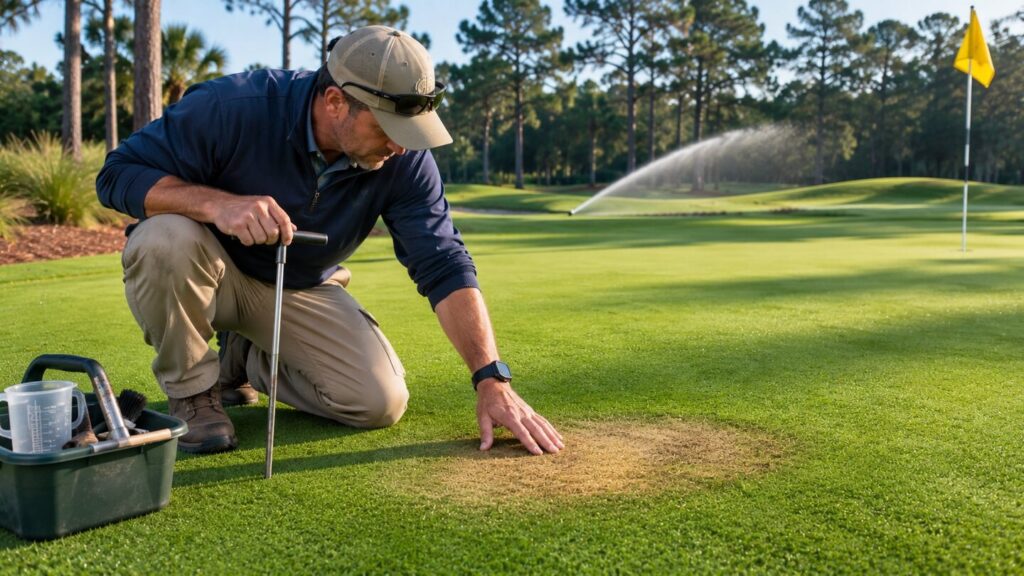
Inspect several healthy and stressed locations. Compare volumetric water content at consistent depths, look at soil cores, test irrigation uniformity, and note drainage, thatch, weather exposure and recent maintenance. Water-repellent sand may cause localized dry spots; other brown patches can reflect insects, disease, salinity, irrigation gaps or root damage. Correct the cause before choosing any additive.
When is improved penetration the goal?
If water beads, runs off, or fails to enter a water-repellent profile, the objective is to improve infiltration and distribution. Geoponics positions Penterra as the penetrant option. Its publicly posted professional label discusses movement of water into and through soil and calls for irrigation after treatment. Surfactants cannot fix a blocked drain, severe compaction or a damaged irrigation system.
When is moisture retention the goal?
If a sand-based root zone wets but dries rapidly between irrigation cycles, the objective is even moisture availability without excess softness. Geoponics positions HumaWet for water retention in the root zone and soil conditioning. The published HumaWet label also calls for immediate post-application irrigation, despite some older marketing pages suggesting otherwise.
If water beads, runs off, or fails to enter a water-repellent profile, the objective is to improve infiltration and distribution.
If a sand-based root zone wets but dries rapidly between irrigation cycles, the objective is even moisture availability without excess softness.

Do “penetrant” and “retainer” labels prove which wetting agent will work better?
No. University of Arkansas research summarized by the USGA found that the marketing categories “penetrant” and “retainer” do not consistently predict differences in root-zone moisture on sand-based putting greens. That research was not a head-to-head trial of Penterra and HumaWet. Use their documented intended functions as a starting hypothesis, then judge results through local soil moisture, infiltration, firmness and irrigation data.
How can you evaluate a small test area?
Choose comparable treated and untreated areas, document baseline moisture and playing-surface firmness, check irrigation depth and uniformity, and repeat readings after the same watering and weather conditions. Record turf quality, localized dry spot symptoms, any surface wetness and labor required. Compare results over time rather than relying only on appearance or a single day’s outcome.
What should I verify about watering-in and label directions?
Use the authoritative current container label for rates, mixing, irrigation timing and equipment. The public HumaWet shopping page is contradictory: its Benefits section says watering-in is unnecessary, while its application directions recommend immediate irrigation. The Penterra product page calls for irrigation after application. Confirm the current instructions with Geoponics before applying; this article deliberately omits application rates.
What if the green stays wet even after irrigation is reduced?
Water that does not leave the root zone can signal layered soil, organic-matter buildup, surface grading, an outlet problem, restricted drainage or a faulty moisture reading. Take cores, compare repeated meter measurements at several depths, examine drainage and scheduling, and consult a turf agronomist. A soil surfactant is not a substitute for repairing a physical drainage restriction.
Water that cannot leave the profile is a different problem from soil that repels water.
Where do physical drainage and irrigation corrections fit?
Surface puddling caused by grading, clogged drainage, irrigation overscheduling, compacted soil or excess thatch needs a physical or scheduling correction. A surfactant may help overcome soil water repellency, but it cannot replace drainage repair, sprinkler calibration, cultivation or disease diagnosis. On golf greens, moisture distribution must also be balanced against firmness and playability.
A quick diagnostic checklist
- Moisture profile measured at repeatable depths
- Irrigation coverage and output verified
- Water repellency versus actual drainage restriction distinguished
- Current container label and mixing compatibility confirmed
- Side-by-side response, firmness and cost recorded

Blade McGreen
Blade’s Tip of the Day: Record moisture at the same depths and spots before and after a trial. A consistent set of readings beats guessing from color alone.
Questions superintendents ask
01What is the best wetting agent for golf greens?+
No product is best under all conditions. Diagnose whether the problem is water penetration, retention, irrigation distribution or physical drainage, then compare products using on-course measurements.
02How do I know if my putting green has localized dry spot?+
Irregular dry patches, water-repellent sand and low soil-moisture readings are warning signs. Confirm with a moisture meter, soil core and irrigation check.
03Is a soil penetrant different from a moisture retainer?+
They are different marketing categories, but the USGA cautions that category alone does not predict the actual field response. Compare site measurements and product-specific evidence; neither Penterra nor HumaWet was directly compared in the cited USGA summary.
04When should I evaluate Penterra?+
Consider Penterra when the diagnosed objective is improving infiltration or percolation; review the published professional label and perform a supervised on-course trial.
05When should I evaluate HumaWet?+
Consider HumaWet when root-zone moisture retention and soil conditioning are the goals; verify whether those needs are measurable on your green.
06Does a wetting agent fix poor drainage?+
No. It may improve wetting of water-repellent soil but does not repair blocked outlets, poor grades, compaction or damaged drainage infrastructure.
07Should soil wetting agents be watered in?+
Follow the current approved container label. The public HumaWet store page has conflicting instructions about watering-in, and Penterra’s page calls for irrigation after application. Confirm the correct instructions with Geoponics before applying either product.
08Can wetting agents replace irrigation audits?+
No. Distribution uniformity, nozzle output, control schedules and irrigation coverage still need to be checked.
09How should I compare treatment results?+
Use paired test and control areas, consistent soil-moisture readings, surface firmness and symptom records across similar watering and weather conditions.
10What should I do if a golf green remains wet despite little irrigation?+
Check the drainage outlet, soil layers, organic matter, irrigation settings and meter calibration. A wetting agent cannot repair physical restrictions; document the cause before choosing a product.