

| 1 DIAGNOSE | 2 MATCH SHADE | 3 TEST & APPLY |
|---|---|---|
| Winter injury / disease? | Fraser Fir / Leyland Cypress | Small test dry evaluate |
Why do evergreens turn brown?
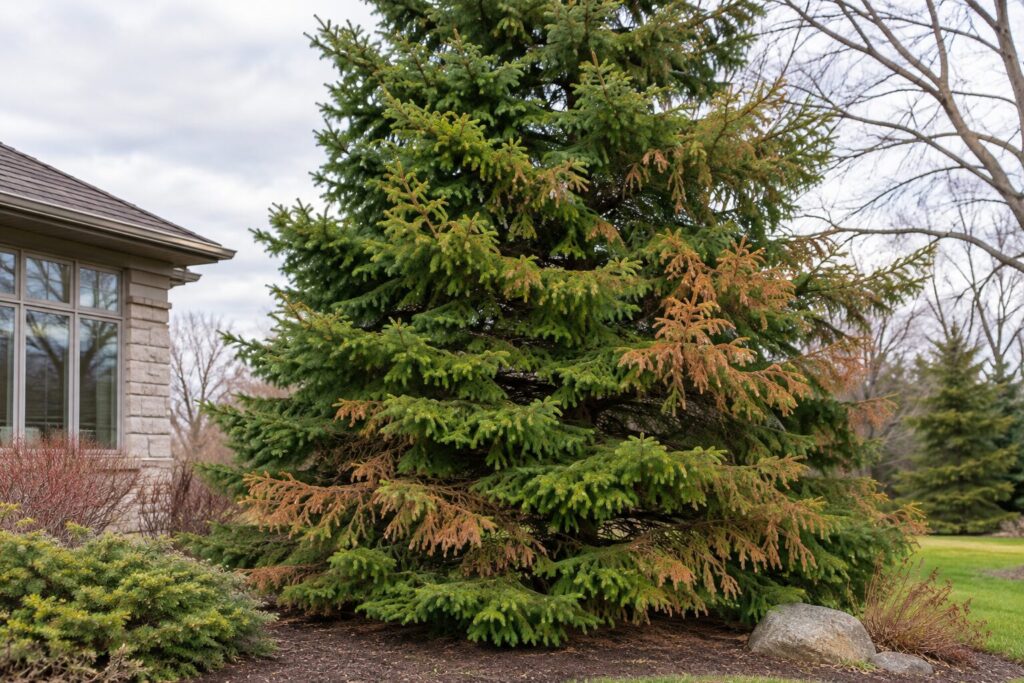
Evergreen foliage may brown after winter sun, dry winds, frozen soils, drought, salt exposure, transplant stress or disease. Winter desiccation is especially common where needles lose water faster than roots can replace it. The University of Minnesota Extension notes that sun- and wind-exposed sides of a plant often show the greatest injury.
Not all browning is winter burn. Disease may produce spotted or banded needles, premature needle drop or dieback that progresses over time. For example, Dothistroma needle blight can create reddish bands and brown needle tips. If symptoms are spreading, unusual or severe, consult an arborist or extension diagnostic service before applying any colorant.
Can a colorant revive dead foliage?
No. A colorant changes the visible color of foliage; it does not restore chlorophyll, repair roots, control a fungus or revive dead needles. Brown winter-damaged foliage often remains brown even when surviving buds later produce new growth. A tree with dead branches or root disease needs appropriate plant care, not cosmetic concealment.
A tree colorant may be useful where the plant or cut greenery is structurally suitable and the goal is a more uniform appearance—for example, selected evergreens, holiday trees, nursery inventory or ornamental landscape displays. Do not use color to hide a potentially hazardous declining tree.
Which Endurant evergreen colorant should you choose?
Endurant Fraser Fir is the deeper evergreen shade intended for Fraser firs and similar darker conifers. Endurant Leyland Cypress is formulated to match a brighter Leyland cypress-type green. Both are tree and shrub colorants; neither should be confused with Endurant turf paint or palm-trunk colorant.
Match the shade to the species and existing foliage, not simply to the darkest green available. Test a discreet branch or sample plant, allow it to dry and evaluate in daylight. If the species is not listed on the current product directions, request technical confirmation before spraying.
What does the published mixing direction say?
The published Endurant Leyland Cypress label gives a garden-sprayer example of 8 US fluid ounces (237 mL) of concentrate per 1 US gallon (3.785 L) of water. It also describes a 15:1 water-to-colorant ratio; these two phrasings are not mathematically identical if one refers to added water and the other to finished volume. For publication, use the explicit volume example and have Geoponics technical staff confirm the correct tank-fill interpretation.
Do not apply concentrate undiluted. The Fraser Fir product guidance also lists 8 US fl oz (237 mL) per 1 US gal (3.785 L) of water. These are manufacturer directions, not an independently established rate for every tree species or sprayer. Confirm the latest label before each job.
Can you use an ordinary garden sprayer?
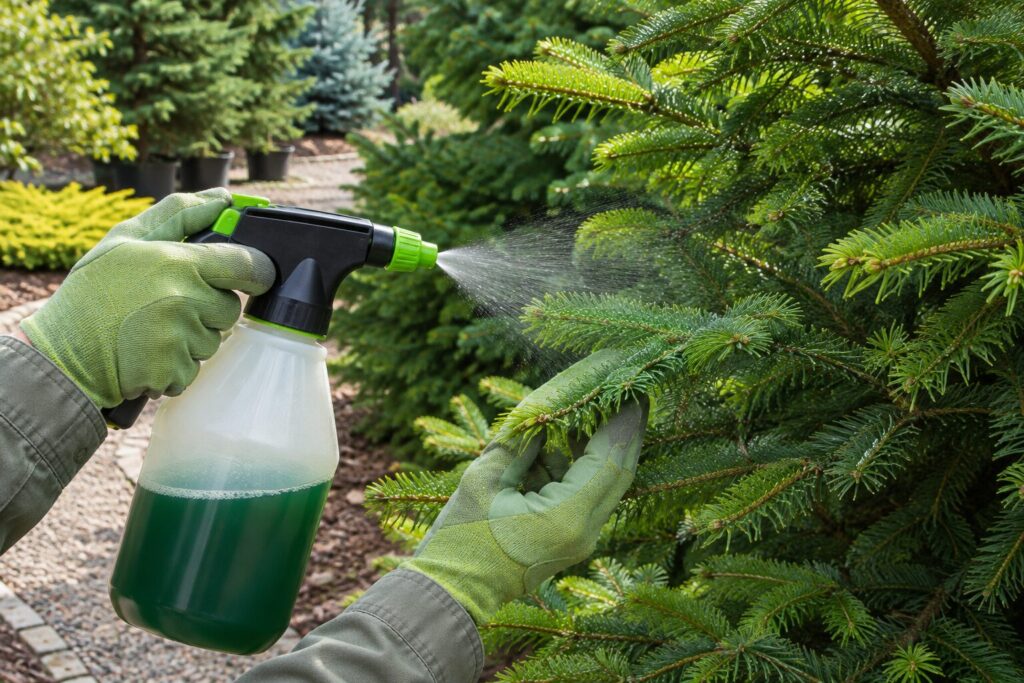
Yes. The manufacturer describes a garden-sprayer method for small applications. Shake the container before mixing because pigment may settle. Wear appropriate protective equipment, protect skin and surfaces, and use a clean sprayer with an adjustable pattern. Apply an even, light coating to foliage rather than saturating one side.
For a tree farm or large landscape project, a calibrated backpack or professional spray system may be more efficient. Consult the manufacturer about nozzles and equipment; do not assume turf boom settings will produce uniform coverage on a three-dimensional canopy. Avoid drift onto sidewalks, pavers, buildings, vehicles and neighboring plants.
How long does the colorant need to dry?
The published evergreen directions say to allow drying for up to 24 hours, depending on humidity and site conditions. Apply when wind and forecast conditions allow controlled spraying and drying; protect nearby surfaces and people until the coating is dry. A second application may be considered after the first is fully dry if the current label allows it.
There is no defensible universal coverage-per-tree figure: tree height, canopy density, foliage texture, spray method and target shade all change consumption. Start with a test area and record actual product use instead of promising a fixed number of trees per container.
What should you do about the underlying plant problem?
Correct the cause of browning whenever possible. Check root-zone moisture, irrigation uniformity, drainage, salt exposure, soil conditions and signs of insects or disease. University of Minnesota Extension recommends protecting susceptible evergreens from winter wind and sun and maintaining adequate moisture before soil freeze-up.
Avoid immediately pruning all brown branches after winter: live buds may still emerge. The extension guidance recommends waiting until spring to assess damage, then removing confirmed dead tissue. Colorant is an appearance tool, not a substitute for horticultural diagnosis and management.
Where does this approach make sense?
For homeowners, a small trial may help improve a visually uneven ornamental evergreen while the underlying cause is addressed. Landscape contractors and municipalities should document plant condition and avoid masking defects that could affect public safety. Tree farms and retailers can evaluate whether color enhancement improves presentation of otherwise suitable inventory.
In every setting, communicate clearly: cosmetic improvement is not proof of plant recovery. Keep before-and-after photographs, note application conditions and provide the client with the product label and care recommendations.
Frequently asked questions
Will brown needles turn green naturally again?
Often not. Dead needles do not recover, although surviving buds may produce new foliage. Identify the cause before assuming the plant is lost.
Can I use lawn paint on a Christmas tree?
Use a product specifically intended for evergreen trees, such as the appropriate Endurant tree colorant. Turf formulations are not automatically interchangeable.
Is 8 fl oz per gallon the right rate for every tree?
No. It is a published manufacturer example for specified evergreen products. Confirm the current label, species suitability and exact tank-fill method before application.
Does tree colorant cure winter burn or disease?
No. It changes appearance only. Irrigation, winter protection, pruning decisions and disease diagnosis remain separate plant-care tasks.
Explore the two Endurant Fraser Fir and Endurant Leyland Cypress evergreen shades and request technical guidance for your species, equipment and site. Always check the current label and SDS before use.
Product links and technical references
- University of Minnesota Extension — Protecting trees and shrubs in winter
- Penn State Extension — Winter injury in ornamental plantings (May 15, 2026)
- University of Minnesota Extension — Dothistroma needle blight
- Geoponics — Endurant Fraser Fir product
- Geoponics — Endurant Leyland Cypress product
- Geoponics — Leyland Cypress product label (PDF)
- Geoponics — Fraser Fir product label (PDF)
Editorial note: This publication is educational. Cosmetic color enhancement does not diagnose or treat plant disease, root failure or structural hazards. Manufacturer product directions should be verified against the current container label.