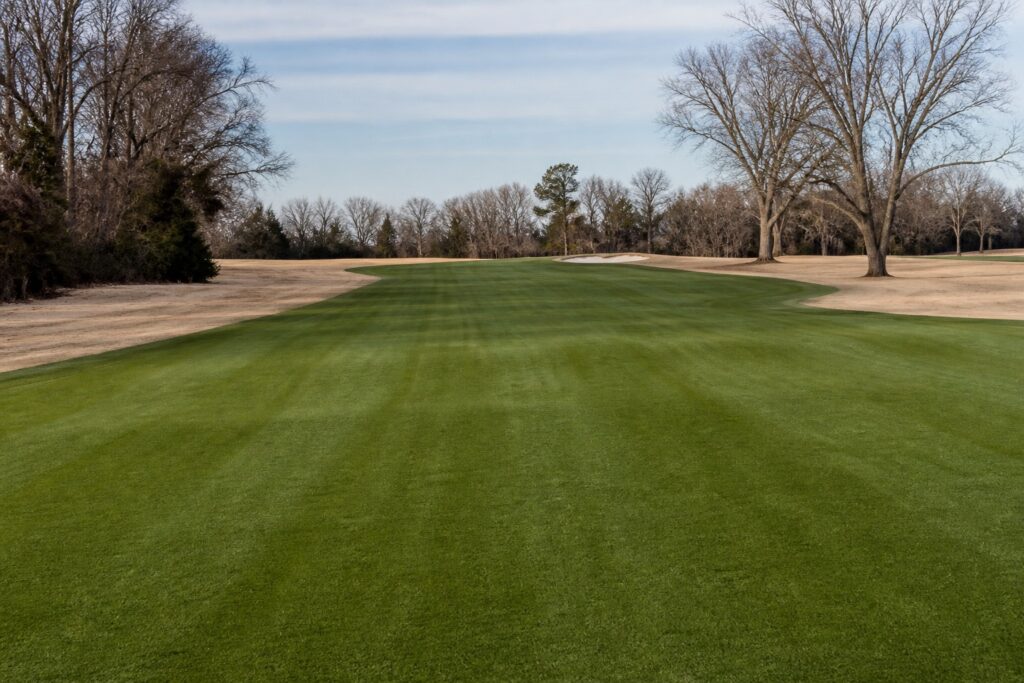
Yes—on many golf fairways, sports facilities and home lawns, a properly selected turf colorant can provide winter-green appearance without planting ryegrass. But it is not a biological substitute for living winter turf: painted dormant bermudagrass cannot recover from wear until growth resumes. The right choice depends on winter traffic, water resources, desired appearance and the spring transition.
What is the difference between overseeding and turf colorant?
Overseeding establishes living cool-season grass, commonly ryegrass, over warm-season bermudagrass. That adds a growing winter canopy, but it also requires seed, establishment irrigation, mowing and management of competition during spring transition.
Turf colorant deposits green pigment or paint onto existing leaf tissue. It can improve visual definition without establishing another grass species. It does not create new leaves, roots, or wear recovery. The USGA’s December 19, 2025 guidance identifies lower water demand and simpler transition as potential advantages, while stressing the limitations of dormant-turf traffic.
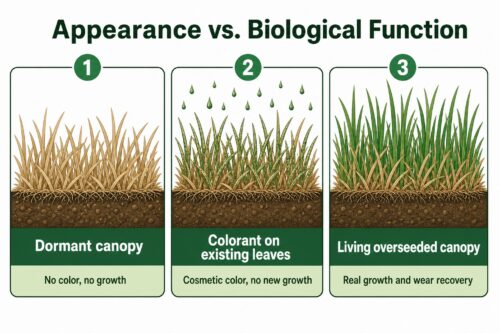
When does a colorant-only winter program make sense?
Consider a colorant-only approach where winter traffic is light to moderate, the bermudagrass canopy is healthy entering dormancy, overseeding is expensive or undesirable, and a smooth spring return to bermudagrass is a priority. Golf fairways, tees, approaches, landscapes and some sports areas can be candidates.
Overseeding may remain preferable where winter wear is heavy and actively growing grass is needed for surface recovery. A green-looking painted field is not necessarily a durable field. Compare site-specific total costs and performance, rather than assuming either method always saves money or water.
Paint versus pigment: choose by turf condition
For fully brown dormant bermudagrass, an opaque, binder-containing turf paint generally provides more natural coverage than a low-rate pigment alone. Endurant Fairway is the darkest of the Endurant turf-paint shades; Premium offers a deep green between Fairway and the lighter Perennial Rye. Choose the shade using a small test area.
Endurant FLEX is a pigment product for transition periods when some chlorophyll remains. Geoponics describes Endurant TE as intended for actively growing green turf, not fully dormant brown grass. Do not substitute a low-rate pigment for a dormant-turf paint solely because the container is cheaper.
How should you time the first application?
Start planning while bermudagrass is healthy and still retains some green. USGA recommends beginning as growth slows, before the canopy becomes uniformly straw-brown. This can improve the visual transition and may reduce the amount of opaque paint needed later.
Mow to the desired winter height and remove clippings, loose leaves and debris. Test the shade on a representative area. Avoid spraying when drift, rainfall, frozen surfaces or poor drying conditions make the label directions difficult to meet. Protect hardscape and adjacent surfaces from overspray.
How do you avoid streaking and uneven coverage?
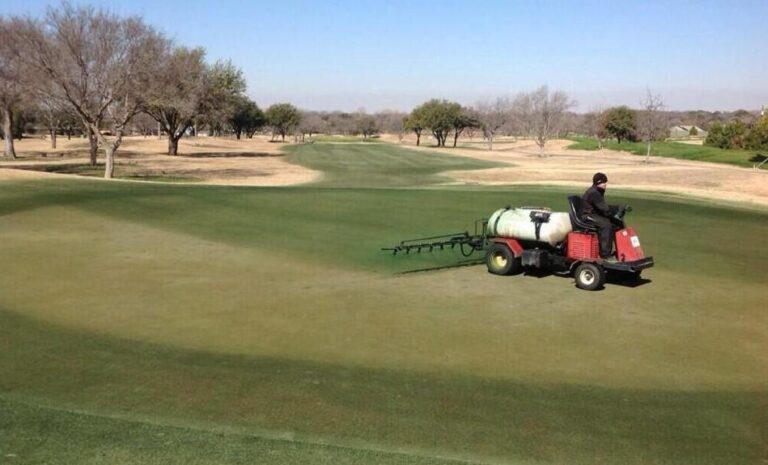
Calibrate the sprayer for its actual nozzle, pressure, ground speed and spray volume. Flat-fan nozzles and deliberate overlapping passes are common professional approaches. For better uniformity, split a planned application into two directions if the current label and equipment allow it.
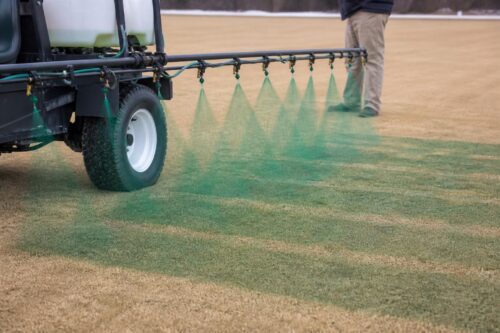
A calibrated boom or skid sprayer suits larger fairways and fields; a battery backpack sprayer can suit smaller landscapes. A manual garden sprayer can be used on small residential areas with an appropriate product and careful technique. Higher pressure by itself does not guarantee better coverage. Agitate and clean equipment according to the product instructions.
What do published rates actually say?
The current online Geoponics Fairway page gives a mixing example of 8 US fluid ounces (237 mL) of concentrate per 1 US gallon (3.785 L) of water. This is a published product-page example—not a universal per-acre program or a replacement for the current label. Coverage depends on canopy density and desired opacity.
The Geoponics FLEX product page lists 32–64 US fluid ounces per acre (2.34–4.68 L/ha) for transitional turf. FLEX is not presented here as a stand-alone solution for completely dormant, fully brown bermudagrass. Confirm the current product label, local rules and sprayer calibration before setting any field rate.
How long does winter color last?
There is no universal duration. NC State Extension reports that colorant performance varies by product, climate and wear; repeat applications can be needed during dormancy. Traffic and mowing can remove colored tissue, while poor coverage can create an uneven appearance.
Monitor treated areas rather than relying on a fixed calendar. Restrict carts and rotate access where possible. Colorants may make dormant turf attractive, but they cannot repair divots or compensate for a worn-out canopy.
What does independent research say?
NC State Extension describes colorants as an established alternative to overseeding and explains the chemistry and application differences between pigments and binder-containing paints. Its guide also cautions that dormant painted turf has no new growth to replace worn tissue.
The USGA documented a Southwestern golf course that replaced overseeding with colorants and reported reduced irrigation in that particular case. That is a site-specific observation, not a universal water-savings promise. Its 2025 guidance likewise emphasizes both benefits and traffic limitations.
Frequently asked questions
Can turf paint replace ryegrass overseeding completely?
It can replace overseeding for winter appearance at suitable sites, but it cannot replace the wear recovery of living ryegrass.
Does turf colorant make dormant bermudagrass grow?
No. Colorant is cosmetic. Any changes in canopy temperature or spring green-up depend on site conditions and should not be promised as a universal result.
Should I use Endurant TE on fully brown dormant bermudagrass?
No. Geoponics describes TE as a color enhancer for turf that still has green chlorophyll. Select a suitable turf paint for fully dormant turf.
Can a homeowner apply turf colorant?
Yes. Small lawns may be treated with a properly calibrated manual or battery sprayer, following the product label and protecting adjacent surfaces.
Plan your winter turf program
For a winter color program, identify the turf species, dormancy stage, traffic level, desired shade and application equipment before choosing an Endurant formulation. Contact Geoponics for product-specific guidance.
Research and product references
- USGA (2025): Colorants in the Southwest
- NC State Extension: Guide to Using Turf Colorants
- USGA: A Southwestern Course Switches from Overseeding to Turf Colorants
- Geoponics: Endurant Turf Paints and Pigments
- Endurant Fairway
- Endurant Premium
- Endurant Perennial Rye
- Endurant FLEX
- All Endurant turf colorants