A practical diagnosis and recovery guide for golf course superintendents.
The short answer
Wetting agents are valuable tools for managing water-repellent soils, but they are not a substitute for diagnosis, irrigation uniformity or sound rootzone management. A localized dry spot may persist after treatment because the rootzone is still too dry, water is not reaching the affected area, organic matter or soil layering is interfering with movement, or the symptom is not caused by water repellency in the first place.
The best response is to confirm the cause, measure the moisture difference, evaluate how water moves through the profile, and select a corrective program based on those observations.
What is localized dry spot?
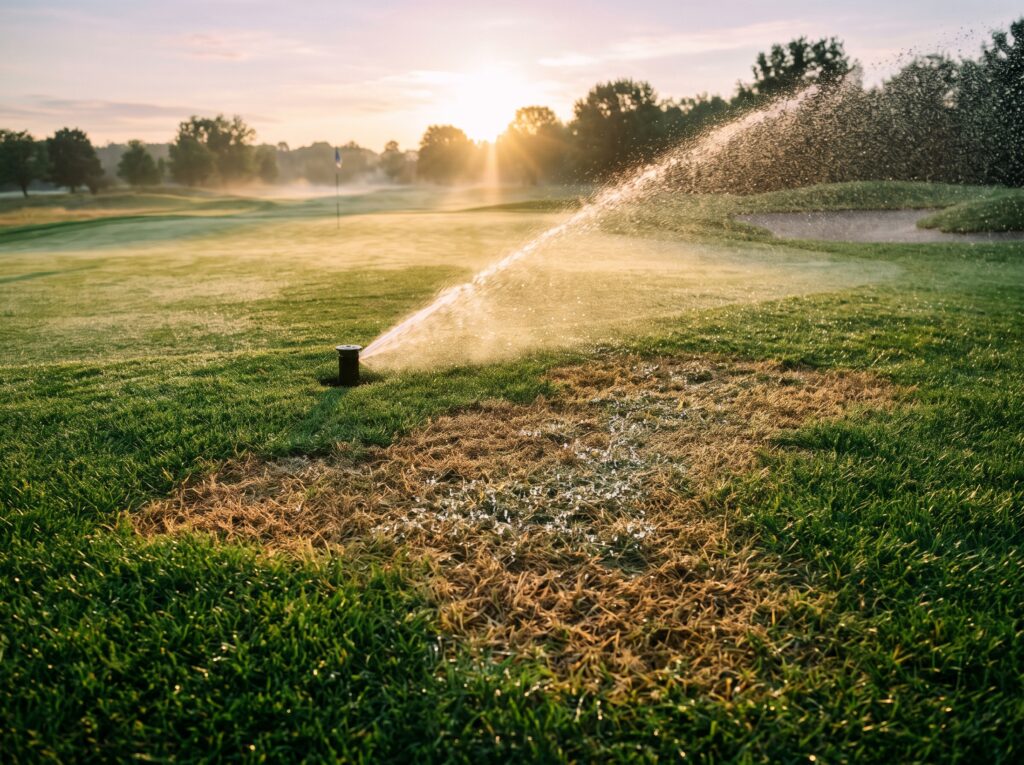
Localized dry spot (LDS) describes irregular areas of turf where soil becomes difficult to wet and turf experiences moisture stress even when nearby areas remain adequately hydrated. Water-repellent, or hydrophobic, conditions can occur when organic compounds coat soil particles. Sandy rootzones and sites managed for firm playing conditions can be especially susceptible.
Brown or wilted turf is not proof of LDS. Irrigation coverage, localized compaction, root loss, disease, salinity, pests and drainage problems can create similar-looking symptoms. A reliable diagnosis starts below the canopy.
Why might a wetting agent application appear unsuccessful?
First, a severely dry rootzone may need adequate irrigation to restore moisture throughout the affected depth. The USGA reported in May 2025 that wetting agents alone do not guarantee correction of LDS and that occasional deep irrigation can be necessary. Frequent, very light irrigation may wet only the surface without restoring the full rootzone.
Second, water distribution may be uneven. Sprinkler arcs, blocked heads, pressure variation, wind and slope can leave one area dry while an adjacent area receives enough water. A wetting agent cannot replace water that never reaches the target.
Third, organic matter, thatch, surface sealing, layering or compaction can influence infiltration and water movement. Aeration, topdressing or venting may be part of a broader program when site conditions warrant.
Fourth, the product and application method may not match the problem. Surfactant chemistries differ in their intended role, persistence and label directions. Applying a product without calibrating the sprayer or checking the manufacturer’s current instructions can produce inconsistent results.
A five-step field diagnosis
- Map the pattern. Record where symptoms occur, including high spots, slopes, green edges, traffic routes and areas outside reliable sprinkler coverage. Photograph the same areas over time.
- Measure moisture. Compare the affected area with healthy turf using a properly calibrated soil-moisture meter. Take readings at consistent depths and locations; do not rely on color alone.
- Examine the rootzone. Remove a small profile sample and compare moisture, rooting, organic layers and compaction. A simple water-droplet penetration observation on a dried soil sample can help identify water repellency, but it should be interpreted alongside field conditions.
- Audit irrigation. Check head operation, distribution uniformity, runoff, slopes and the depth actually wetted. Use catch containers or a professional irrigation audit where appropriate.
- Correct and reassess. Combine appropriate wetting-agent use with targeted irrigation, hand watering, venting, aeration or topdressing as indicated. Record moisture readings and turf response before deciding whether to repeat or change treatment.
Preventive programs versus rescue treatments
Preventive wetting-agent programs may help limit the development of water-repellent conditions before visible LDS appears. Rescue treatments on already-dry areas may require more attention to irrigation and physical water entry into the rootzone.
Neither approach has one universal schedule. Rootzone composition, organic matter, climate, irrigation quality, turf species and product chemistry affect the appropriate timing and response. Evaluate results rather than assuming that a fixed calendar program will work everywhere.
Where Geoponics soil products may fit
Geoponics offers several soil-water management products with different positioning. Duration is marketed as a soil wetting agent for moisture distribution and localized dry spot management. Humawet combines surfactant positioning with humic components. Penterra is positioned as a soil penetrant for helping water move through difficult-to-wet soil.
These products should not be presented as interchangeable, and no specific Geoponics product has been independently established by the sources cited here as superior for a particular rootzone. The appropriate selection depends on diagnosis and current label directions. Consult the product label and Geoponics technical team for rates, compatibility and irrigation requirements before treatment.
Can wetting agents reduce irrigation water use?
Improved soil moisture uniformity can help turf managers avoid repeatedly overwatering healthy areas while trying to correct isolated dry spots. The USGA has documented individual golf-course case studies reporting water savings after wetting-agent programs, but these are site-specific observations, not a guaranteed percentage reduction for every course or product.
The most defensible way to evaluate a program is to record irrigation inputs, moisture uniformity, turf response and playing conditions before and after implementation.
Frequently asked questions
Can a wetting agent repair dead grass?
No. It may improve soil wetting where water repellency is involved, but dead tissue must be replaced through turf growth or renovation.
Why is one spot dry while the rest of the green is wet?
Potential causes include hydrophobic soil, sprinkler distribution, rootzone variation, elevation, compaction or different rooting conditions. Measure and inspect before choosing a treatment.
Should I keep watering lightly every night?
Not necessarily. Repeated light irrigation may fail to rewet a deeply dry profile. The right approach depends on soil conditions, runoff risk, turf needs and local guidance.
Does a wetting agent fix poor drainage?
Not by itself. Excessive moisture and inadequate drainage require separate diagnosis. Improving infiltration at the surface does not eliminate a restrictive layer or failed drainage system.
Conclusion
Localized dry spot management works best when wetting agents are one part of a measured agronomic program. Confirm water repellency, assess irrigation coverage, examine the rootzone, and use moisture readings to determine whether the treatment is working. The goal is not simply to apply more product. It is to achieve more uniform and appropriate rootzone moisture while preserving healthy, playable turf.
Related Geoponics resources
Research references
- USGA, What Is Localized Dry Spot? (May 4, 2018)
- USGA, Managing Localized Dry Spot: Beyond Wetting Agents (May 16, 2025)
- USGA, Factors to Consider When Developing a Wetting Agent Program
- USGA, LDS Season Is Here
Technical educational resource. Verify product labels and site conditions before application.