

Short answer: Yes, an otherwise healthy Sylvester palm trunk can be recolored for appearance, but only after you rule out injury or disease and confirm the current product directions. Colorant cannot restore diseased tissue or repair a declining palm.
Why does a Sylvester palm trunk look gray or faded?
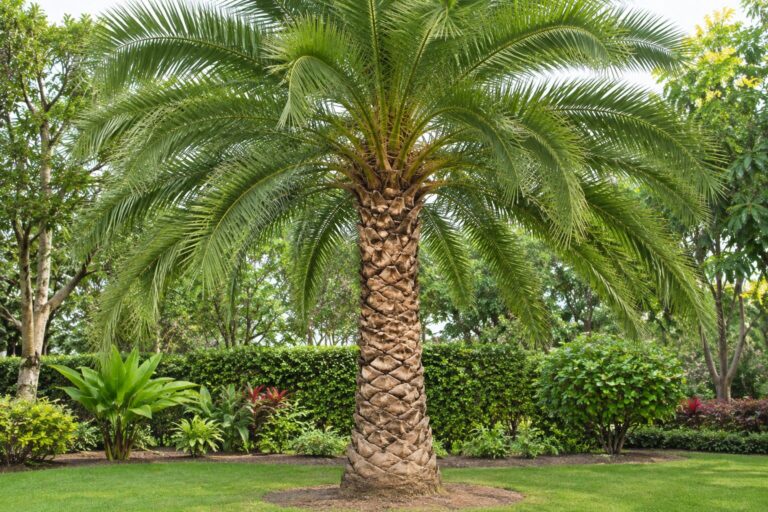
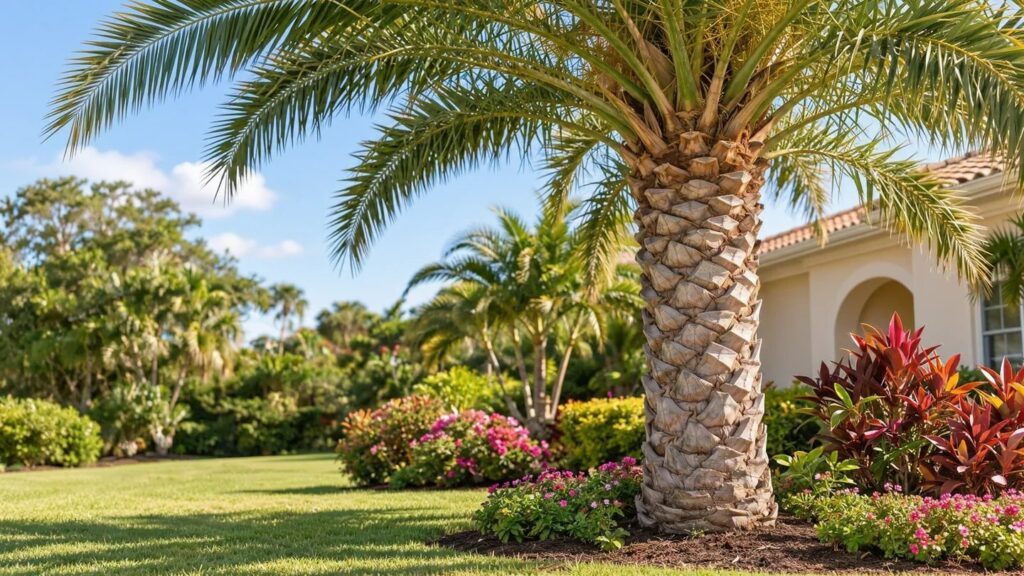
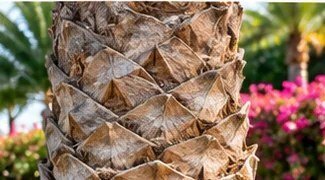
Sylvester palms (Phoenix sylvestris) develop a distinctive trunk with old leaf-base patterns. Sun exposure, irrigation deposits, dust, previous pruning and normal weathering can change how this surface looks. A change in color alone does not establish disease.
Compare the appearance of the trunk with the crown. A normal-looking canopy and firm, intact trunk may indicate a cosmetic issue. Yellowing or wilting fronds, an unusual lean, damaged tissue or growths near the trunk base warrant a different investigation.
When should you inspect the palm instead of painting it?
Stop cosmetic work when the palm has a declining crown, fresh wounds, oozing, unexplained cavities, significant lean or shelf-like fungal growth near the lower trunk. UF/IFAS describes a Ganoderma conk as an important sign of internal decay; the trunk can still feel hard while diseased. Seek a qualified palm professional for diagnosis and safety assessment.
A colorant does not prevent Ganoderma butt rot, cure an infection, reverse nutrient problems or stabilize a structurally compromised palm. Avoid cutting healthy trunk tissue or force-removing attached leaf bases simply to improve appearance.
How should a healthy, faded palm trunk be prepared?
Inspect and photograph the trunk before any cosmetic work. Remove only loose dust and surface debris gently; avoid abrasive scraping, pressure washing or damaging live tissue. Mask surrounding paving, foliage, flower beds and stonework because colorants may stain.
Test an inconspicuous section and evaluate the appearance in daylight. Apply only when the current product label confirms the species, method, dilution, drying conditions and necessary protective measures. The older publicly available Palm Colorant label contains conflicting statements about applying it undiluted, so this article intentionally provides no mixing ratio until Geoponics supplies a corrected current label.
What is the best product for a faded palm trunk?
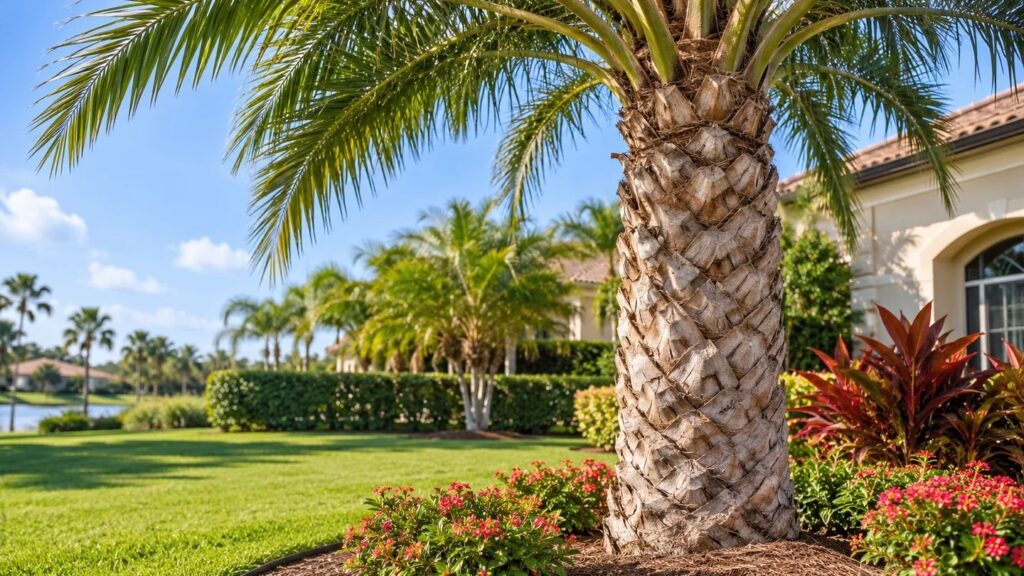
Choose a dedicated palm-trunk colorant for an appropriate cosmetic application—not ordinary house paint or a wood stain. Endurant Palm Colorant is a Geoponics option specifically marketed for palm trunks. Use suitability and label instructions, not a “best for every palm” claim, to decide.
A decorative finish changes appearance; it does not provide proven disease treatment, pest control or guaranteed longevity. Additional products such as Shine n Shield require their own current directions and compatibility checks rather than an automatic recommendation.
How do you estimate the surface area without inventing coverage?
For planning only, multiply trunk circumference by the vertical height you intend to treat. For example, a section measuring 3 ft (0.91 m) around by 8 ft (2.44 m) tall has approximately 24 sq ft (2.23 m²) of surface area.
This is geometry, NOT a product coverage claim. Raised leaf bases, bark texture, masking and application method can substantially change material consumption. Geoponics should confirm coverage and current label instructions before a purchase quantity is recommended.
Does a glossy sealer make the palm healthier?
Do not assume so. Shine n Shield is offered for a cosmetic finish, but specific protective or compatibility statements require confirmation against its currently approved directions. Avoid claiming it prevents rot, pests, UV damage or that a result lasts a fixed number of months without supporting evidence.
A palm with suspected disease should be evaluated rather than coated. The most valuable first step is an accurate diagnosis, not additional cosmetic layers.
Endurant Palm Colorant
Use only if the current approved product directions match your situation. Appearance enhancement is not treatment of disease.
Look at the whole palm, especially the crown and the base of the trunk, before deciding that fading is only a cosmetic problem.
FAQ
Can a faded palm trunk be recolored?
Potentially, when the palm is healthy and the current palm-colorant label supports the use; first inspect the tree and protect nearby surfaces.
Does gray trunk color mean a Sylvester palm is sick?
Not necessarily. Weathering, old leaf bases, dust and irrigation residues may change trunk appearance without proving disease.
What palm warning signs require a professional?
Crown decline, significant lean, unexplained damage, oozing or a shelf-like conk near the trunk base warrant a qualified palm assessment.
Should I use house paint or a wood stain on a palm?
Use only a product intended and labeled for the application; household paint and wood stain are not substitutes for palm-trunk product directions.
How much palm colorant is needed?
Estimate trunk surface area from circumference times height, then follow verified product coverage information; the surface-area estimate alone does not predict usage.
Will coloring protect a palm from disease?
No disease-control benefit is established by cosmetic recoloring. Do not cover symptoms or substitute colorant for diagnosis and treatment.