

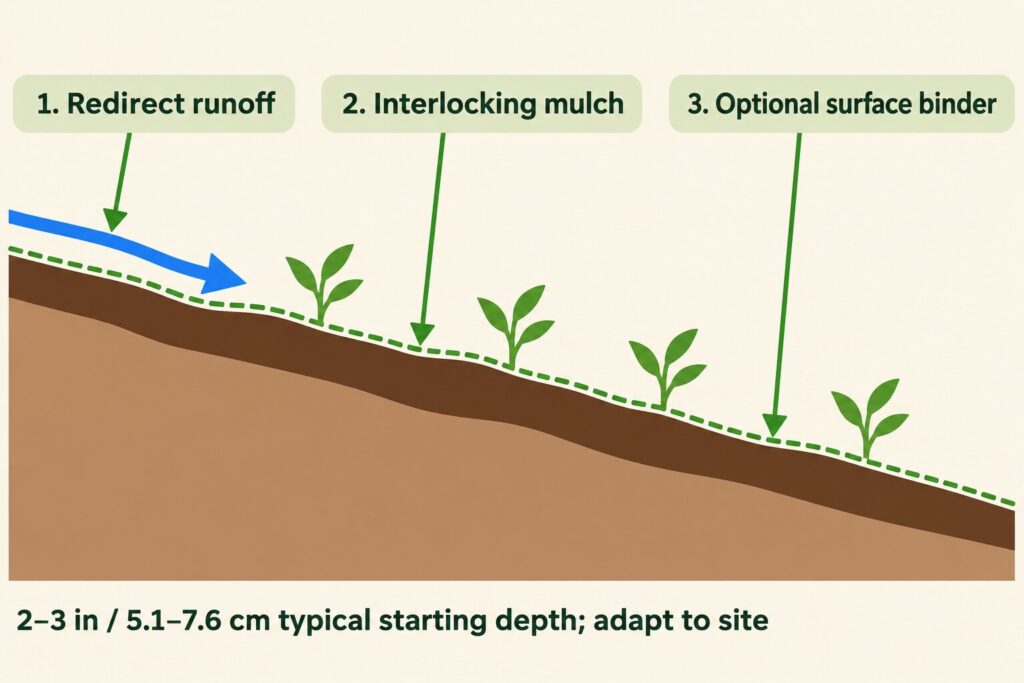
To help keep mulch from washing away, first redirect concentrated runoff, choose a mulch that interlocks, and maintain an appropriate depth. On suitable beds, a surface binder such as MulchCrete can help reduce movement after curing. A colorant such as Endurant Mulch Colorant restores appearance but is not a substitute for erosion control.
Why does mulch wash away?
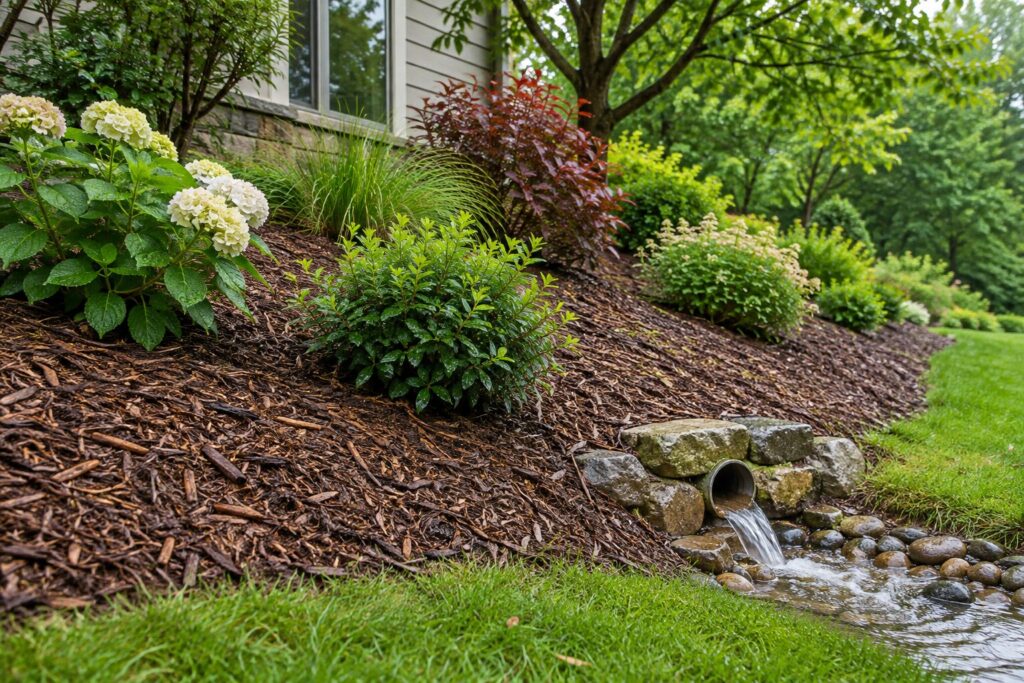
Mulch shifts when rainwater flows across the bed faster than the material can resist. Downspouts, irrigation overspray, steep grades, smooth bark chips, and poorly edged beds can all contribute. A binder may help with scattered material, but it cannot repair a drainage problem or stabilize a failing slope.
The U.S. Environmental Protection Agency recommends additional stabilization such as matting, netting or tackifiers for steep or highly erodible sites. Iowa State University Extension also recommends controlling water flow and using coarse, interlocking mulch on hillsides.
Choose mulch and depth before applying any binder
For many landscape beds, a 2–3 in (5.1–7.6 cm) layer is a practical starting point, subject to material and soil conditions. Iowa State advises 3–4 in (7.6–10.2 cm) of wood chips or shredded bark on well-drained sites, but 2–3 in (5.1–7.6 cm) on heavier soils. Count existing mulch before topping up.
Shredded or fibrous mulch tends to knit together better on slopes than smooth, round pieces. Keep mulch off stems and tree trunks. Where water is concentrated into channels, use drainage correction, plant roots, edging, terracing or engineered erosion-control measures rather than relying on a spray alone.
What does MulchCrete do?
MulchCrete is Geoponics’ water-based ground-cover adhesive for mulch, bark, pine straw, decorative rock and similar materials. Its intended role is to help bind loose surfaces and reduce displacement from ordinary wind, maintenance and some rainfall exposure. It is not a structural retaining system, a guarantee against flooding or a replacement for a properly designed stormwater practice.
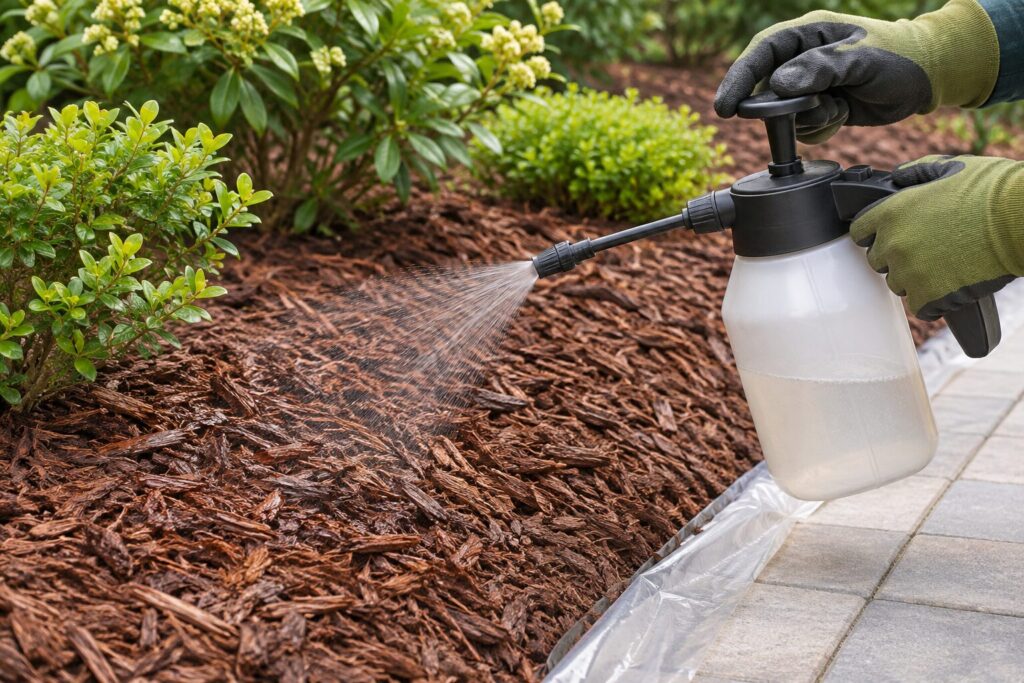
Geoponics describes spray application to dry material with even, overlapping passes. Published company pages give differing cure windows; for planning, allow a conservative 24–48 hours of suitable dry conditions and confirm the current product label and weather requirements before work. No MulchCrete mixing or coverage rate is specified here because published guidance differs and must be reconciled against the current label.
Mulch binder versus mulch colorant: different jobs
MulchCrete is intended to help stabilize the surface. Endurant Mulch Colorant is intended to refresh the appearance of faded mulch, bark or pine straw in colors such as black, brown, cypress red and pine straw. A better-looking bed is not necessarily a more stable bed.
Geoponics’ published Mulch Colorant instructions specify 8 US fl oz per 1 US gal of water (237 mL per 3.785 L, equivalent to about 62.5 mL/L of water). This is a documented published instruction, not confirmation of the current label; check the label on the product being used before mixing. Protect concrete, pavers and foliage from overspray and allow colorant to dry before any separate binder treatment.
Step-by-step: a practical landscape-bed workflow
- Trace runoff during rain. Correct downspout discharge, irrigation runoff and channels before treating the bed.
- Remove debris and weeds. Regrade or edge the bed as needed, then select a coarse or shredded mulch suitable for the site.
- Spread mulch evenly; for many beds use 2–3 in (5.1–7.6 cm), adjusted to soil and material. Keep the root flare and stems clear.
- If color is faded, test Endurant Mulch Colorant on a small area, mix only at the current labeled rate, shield adjacent surfaces and allow to dry.
- On a dry, suitable bed, apply MulchCrete with compatible clean spray equipment according to its current label. Avoid pooling and clean the sprayer promptly.
- Protect the treated area from rain, irrigation and foot traffic through the label-specified cure period; inspect after the next significant storm and adjust drainage if needed.
What equipment is appropriate?
For small beds, a clean manual 1 US gal (3.785 L) pump sprayer may be practical if the current label permits that equipment. Larger landscape crews may use compatible battery-powered backpack or commercial sprayers. Confirm nozzle and seal compatibility, keep the spray pattern uniform, and avoid drift onto hardscape or plants.
A mulch stabilizer should not be applied where it could interfere with intended infiltration, sensitive planting, public drainage structures or local environmental requirements. Test a small area and consult site specifications for municipal, commercial or water-adjacent projects.
Frequently asked questions
Will mulch glue stop every washout?
No. A binder may reduce ordinary mulch movement, but concentrated runoff, steep unstable slopes and flooding require site-specific drainage and erosion-control measures.
Is mulch colorant the same as mulch glue?
No. Endurant Mulch Colorant improves color; MulchCrete is a surface stabilizer. Their functions are distinct.
Can I spray mulch glue immediately before rain?
Do not plan that. Start with dry material and allow the full current-label cure period under appropriate weather conditions.
Should I keep adding mulch to prevent erosion?
Not automatically. Excess depth can restrict water and oxygen near roots. Measure the existing layer, select the right texture and address runoff first.
For homeowners, contractors, golf facilities and municipal landscape teams, the best results begin with water management and appropriate mulch selection. Where suitable, MulchCrete can be part of the stabilization plan and Endurant Mulch Colorant can restore curb appeal. Always use current product labels and site-specific professional judgment.
Technical references and product resources
- U.S. EPA — Mulching BMP
- Iowa State University — Gardening on Slopes
- Rutgers — Problems With Over-Mulching
- Geoponics — MulchCrete Product
- Geoponics — Endurant Mulch Colorant
- Endurant — Published Mulch Colorant Instructions