


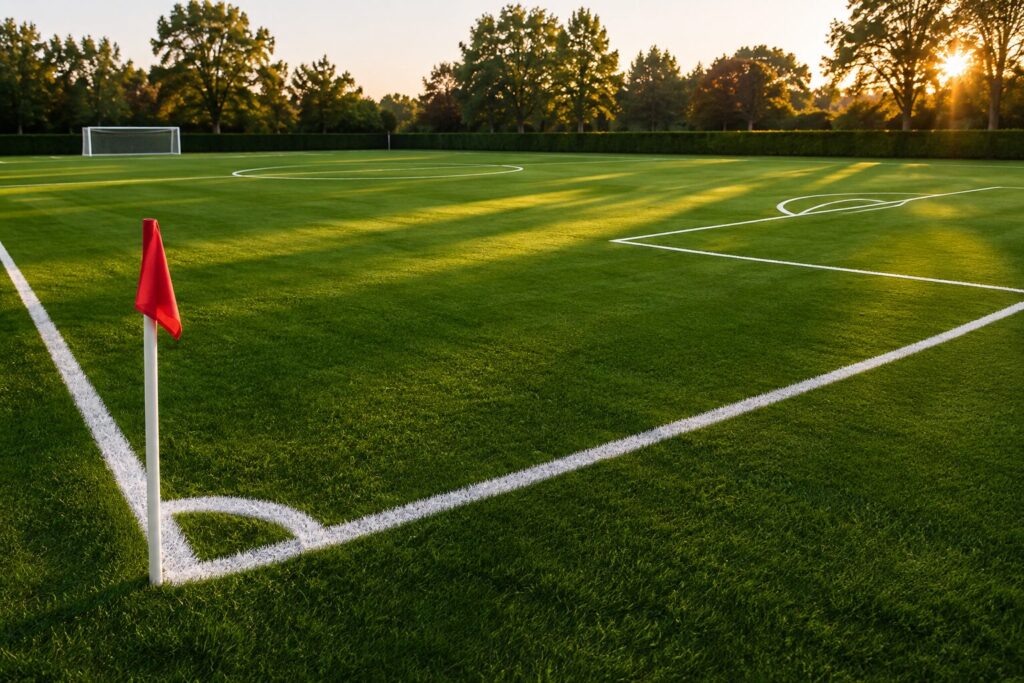
Direct answer. The best way to paint sharp soccer field lines is to start with the correct field dimensions, select paint approved for the surface and machine, calibrate the line width and flow, then test a short section before marking the full pitch. Endurant Great White is marketed for natural-grass field marking and multiple application systems, but robot and nozzle compatibility must be confirmed for each setup.
Start with the field, not the paint
A clear line begins with an accurate layout. Confirm the competition rulebook, surface type, field dimensions and required line width before mixing paint. Under IFAB Law 1, soccer markings must be continuous, safe and the same width, with a maximum of 12 cm (about 4.7 in; the rule also rounds this to 5 in). The exact width and layout for a particular competition should be confirmed with its organizer.
Mow and inspect natural grass before marking. Remove debris, check sprinkler heads and obstacles, and establish permanent reference points outside the playing surface where permitted. The Sports Field Management Association (SFMA) recommends planning paint work around the event schedule and using appropriate field-preparation practices.
Choose the applicator that fits the operation
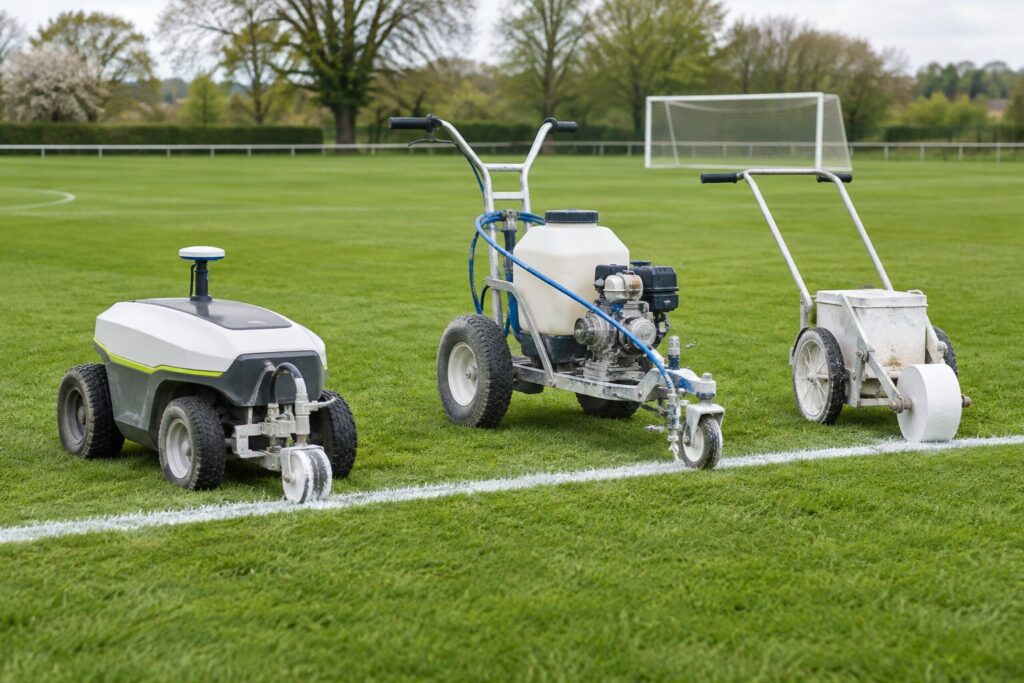
Robotic line markers are useful when a venue repeatedly marks one or many pitches and wants repeatable digital layouts. A robot still needs a paint-and-nozzle combination validated for its pump, filters, hoses and operating settings. Never assume that every paint marketed as robot-friendly is approved by every robot manufacturer.
Airless or powered spray line markers can offer flexible flow and good productivity, but overspray, fan width, walking speed and pressure must be calibrated. Wheel-to-wheel transfer markers can give well-defined edges when the grass surface is even and the wheel is maintained. Manual or battery sprayers are practical for touch-ups and smaller facilities when the operator uses guides and consistent technique.
No machine guarantees a crisp line by itself. Uniform coverage depends on paint condition, agitation, nozzle or wheel setup, travel speed, overlap and the height and density of the turf canopy.
Where Endurant Great White fits
Geoponics describes Endurant Great White as a white athletic line paint for natural turfgrass, gravel, stone and dirt, with temporary marking applications on some other surfaces. Its existing product communications also discuss line stripers and robotic applicators. The product is offered in a 5-US-gallon pail (18.9 L), according to the current Geoponics product page.
Treat the specific SKU, current label and equipment instructions as controlling. Do not assume a universal dilution ratio, dry time, coverage per gallon or compatibility with a particular robot. Before a production run, confirm the selected formulation, whether it is ready-to-use or concentrated, required agitation, acceptable filtration and nozzle specifications with Geoponics and the equipment supplier.
On synthetic turf, obtain the turf manufacturer’s approval and test cleanability and residue in an inconspicuous area. A product suitable for natural grass is not automatically appropriate for every synthetic fiber, infill or coating.
A five-step field-marking workflow
- Measure and document: verify the rulebook, line width and field geometry. Mark reference points, then photograph or save the layout.
- Inspect and prepare: mow as appropriate, clear clippings, check turf moisture and remove field hazards. Avoid painting over loose debris or standing water.
- Check product and machine: read the current label and safety data sheet, mix or agitate only as instructed, check filters and nozzles, and test flow with water when appropriate for the machine.
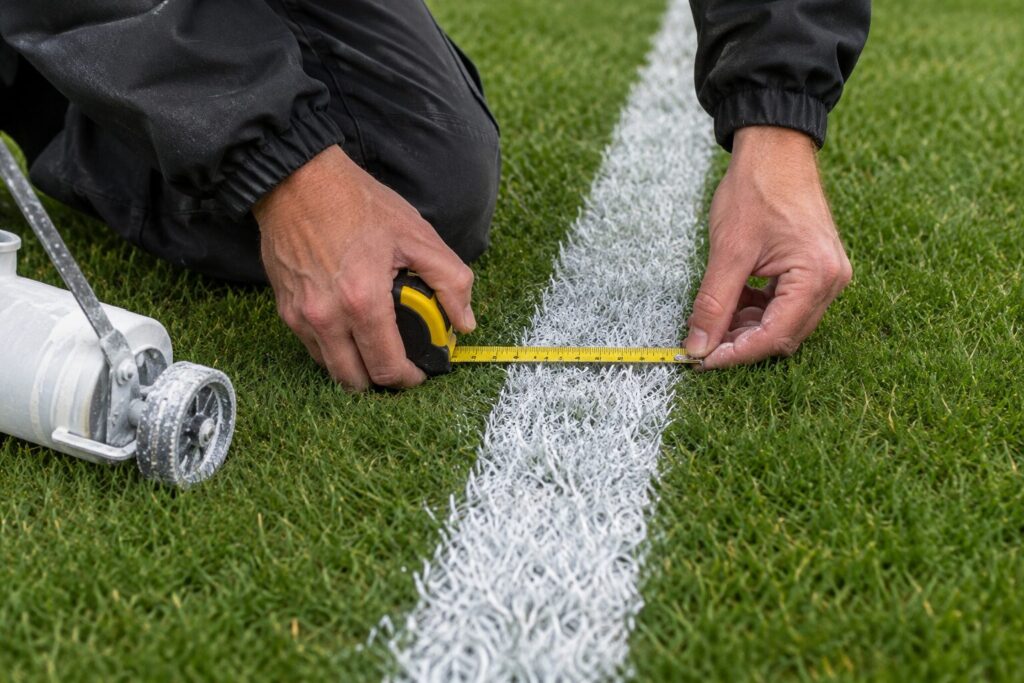
- Test before the full pitch: paint a short line, measure its width, assess opacity and edge quality, and adjust speed or flow before proceeding. Keep pressure and travel speed consistent.
- Protect the finished work: allow drying according to conditions and the current product instructions. Inspect lines before play; clean equipment in a manner that keeps paint wash water out of storm drains.
Common problems and what to check
Fuzzy edges often point to an incorrect nozzle, excess pressure, overspray, poor guides or an uneven canopy. Thin or transparent lines may reflect inadequate agitation, insufficient flow, excessive speed or a mismatch between paint and turf. Uneven line width may result from inconsistent walking speed, wheel alignment or an incorrect robot setting.
Repeated heavy paint build-up is not a substitute for calibration. SFMA best-practice guidance cautions that frequent accumulation of some field-paint ingredients can affect soil and turf. Keep a simple log of product, lot, dilution if any, equipment, weather, line width and observations so future applications can be improved.
Frequently asked questions
Can Endurant Great White be used in a robot?
Geoponics markets it for robotic line-marking applications, but verify the specific robot, nozzle, pump and product formulation before use.
What is the maximum soccer line width?
IFAB Law 1 states 12 cm (about 4.7 in; often shown as 5 in). Follow the governing competition’s specifications.
Can one paint be used on natural and synthetic turf?
Not automatically. Obtain surface-manufacturer approval and test for staining, residue and removal.
Should I dilute Great White?
Follow the current label for the exact Great White product supplied. This guide intentionally does not prescribe a dilution rate without verified product-specific instructions.
Get technical guidance
For a line-marking recommendation tailored to your grass, field size, equipment and event schedule, contact Geoponics Corp. Review the Endurant Great White product page and the independent IFAB and SFMA resources listed below. This article is educational and does not supersede product labels, machine manuals or competition rules.
Verified references and product information
- Endurant Great White product page
- Geoponics field-paint overview
- IFAB Law 1: The Field of Play
- SFMA Best Management Practices for the Sports Field Manager
- SFMA Sport Field Painting Tips